By Oluwaseyi Adaralegbe | Lagos Property Intelligence
Estimated reading time: 5 minutes
Tags: Nigerian real estate · diaspora property investment · Lagos property due diligence · property title verification · real estate agent Nigeria
The single biggest barrier to real estate investment in Nigeria is not price, availability, or returns. It is trust.
Buyers, particularly diaspora buyers, have been burned. Titles have been disputed. Developments have not been delivered. Agents have collected commissions and vanished before keys changed hands. And the informal, relationship-driven nature of most transactions means that when something goes wrong, there is often no paper trail, no escrow, and no recourse.
This is the context in which BCR operates. This article is an honest accounting of that problem and a practical guide for buyers who want to navigate it.
The trust deficit in Nigerian real estate is not abstract. It shows up in specific, repeatable ways.
The most common: a buyer purchases a property based on documentation provided by the seller or their agent, only to discover post-completion that the title is encumbered, disputed, or outright fraudulent. This is not rare. Land in Lagos — particularly in pre-construction corridors like Ajah, Ikorodu, and parts of the Lekki axis — has been sold multiple times over by different parties claiming the same ownership rights.
The second pattern: a buyer pays a deposit or full purchase price on an off-plan development, the developer encounters funding challenges, and the project stalls or is abandoned entirely. Without proper escrow structures or milestone-linked payment schedules, the buyer has little formal protection. Legal action is available — but slow, expensive, and uncertain in outcome.
The third pattern is the agent problem. A buyer finds a property, an agent facilitates the transaction, commission is paid, and then the agent is unreachable if any issues arise. The incentive structure in an unregulated market rewards the completion of transactions, not client outcomes.
Understanding that these are the actual failure modes, not isolated incidents, but structural patterns is the starting point for navigating the market safely.
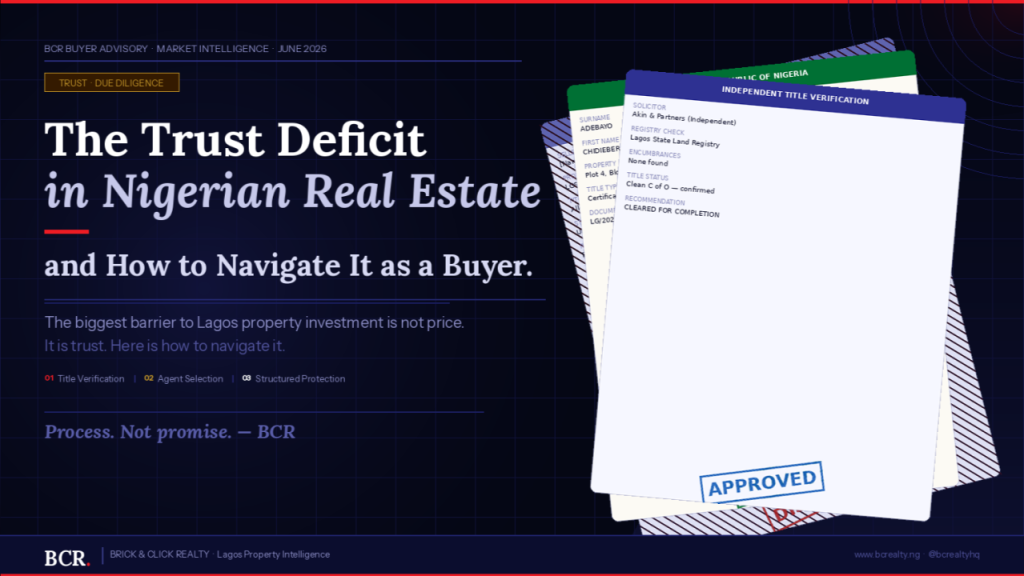
Title verification is not optional. It is the foundational step that every buyer must complete before any money changes hands.
The standard in Lagos is to engage an independent solicitor — not the developer’s legal team, not the agent’s recommended lawyer, but an independently instructed legal professional — to conduct a title search at the Lagos State Land Registry. This search confirms whether the title is genuine, whether there are any encumbrances, and whether the property has been the subject of prior transactions.
The documents to verify, in order of importance: the Certificate of Occupancy (C of O) is the strongest title document in Lagos. A Global C of O covering an estate is common in well-managed developments. Governor’s Consent is required for any subsequent transfer of a C of O property. Allocation Letters and other derivative documents carry more risk and require additional scrutiny.
For off-plan purchases, add developer verification to your checklist. Confirm that the developer has a valid development permit. Confirm that the land on which the project sits has clean title. Confirm that the company is registered with the Corporate Affairs Commission and has completed prior projects that you can physically inspect.
This process takes time. It costs money — typically 1–2% of the property price in legal fees. It is the most important money you will spend on any property transaction.
There is no formal licensing body for real estate agents in Nigeria. The Estate Surveyors and Valuers Registration Board of Nigeria (ESVARBON) governs valuation professionals, but routine property brokerage remains largely unregulated.
What separates a credible agent from an opportunistic one is not always visible at first contact. The signals to look for: does the agent discuss due diligence before they discuss commission? Do they provide written documentation of their mandate to sell the property? Do they have a verifiable track record of completed transactions with clients you can contact independently?
The signals to avoid: agents who pressure urgency without providing documentation. Agents who cannot produce a developer’s mandate or a title summary. Agents whose communication becomes inconsistent after an offer is made. Agents who resist the involvement of independent legal counsel.
The best agent you can work with is one who makes the process slower and more documented, not faster and more informal. In a trust-deficient market, process is protection.
Not all developers in Lagos carry the same risk profile. The markers of a credible developer are specific.
Green flags: a track record of completed projects that buyers can physically visit. A registered company with auditable accounts. A payment structure that ties releases to construction milestones. A willingness to provide escrow arrangements for off-plan deposits. Transparent documentation of land title, development permits, and professional team credentials.
Red flags: pressure to commit before documentation is available. Payment requests via personal accounts rather than registered company accounts. A project that cannot show you a comparable completed development. Marketing materials that emphasise projected returns over project fundamentals. Any resistance to independent legal verification.
The Lagos developer market includes genuinely credible operators — some of BCR’s confirmed developer partners — alongside opportunistic actors who exploit the trust deficit rather than address it. The distinction is detectable through process, not marketing language.
The most effective structural protection for a property buyer in Nigeria is a well-drafted purchase agreement combined with a milestone-linked payment schedule and, where available, escrow for off-plan deposits.
A purchase agreement that protects the buyer should specify the exact property being acquired (survey plan reference, title document details), the full purchase price and payment schedule, completion timelines with defined penalty clauses, conditions precedent to completion (title confirmation, permits), and dispute resolution mechanism (arbitration is preferable to litigation for speed and certainty).
Milestone payments — where the buyer releases funds as construction reaches defined stages rather than in advance — protect off-plan purchasers against developer funding failure. If a developer cannot agree to a milestone structure, that resistance is informative.
Escrow — where purchase funds are held by an independent solicitor or trust company pending completion — is the gold standard. It is not yet standard practice in Lagos for most transactions below ₦500M, but it is increasingly available and worth negotiating for on any significant purchase.
The trust deficit creates an inefficient market. Buyers spend months in decision paralysis. Credible developers compete with fraudulent operators for the same buyer attention. Prices are discounted to reflect the risk that documented transactions should not carry.
When trust is present — when a buyer arrives with independent legal counsel, a clear brief, and a mandate to complete a documented transaction, the market responds differently. Sellers with clean title who want a credible buyer engage faster. Developers with strong track records are more willing to provide escrow and milestone structures. Transactions close in weeks rather than months.
BCR’s commercial experience consistently confirms this. The buyers who complete transactions fastest are not the ones with the most urgency. They are the ones with the most preparation. A buyer who arrives with a legal brief, a due diligence checklist, and a realistic timeline closes more deals at better prices than one who arrives with only capital and enthusiasm.
The Nigerian real estate market’s trust deficit is real. It has cost buyers significant capital, led to years of legal disputes, and suppressed investment the market could otherwise absorb.
It is also navigable. Not by relying on relationships or reputation alone — but by insisting on process. Independent title verification. Independent legal counsel. Developer track record confirmation. Documented mandates. Structured payment terms. A purchase agreement that allocates risk clearly.
These are not complex requirements. They are the minimum standard that a buyer in any well-functioning property market would expect. Applying them in Lagos does not eliminate risk but it transforms the risk profile from opaque to legible. And a legible risk is a manageable risk.
BCR was built specifically for buyers who value process over promise. If you are considering a property purchase in Lagos and want a transaction structured with the rigour outlined in this article, we are the right partner to have that conversation with.
About Brick & Click Realty
BCR is a Lagos-based luxury real estate brokerage operating across Ikoyi, Victoria Island, Banana Island, Lekki Phase 1, and Oniru. BCR provides data-driven advisory, investment briefs, title verification coordination, and transaction management for local HNIs and diaspora professionals.
Contact: info@bcrealty.ng | +234 803 395 1945 | www.bcrealty.ng | @bcrealtyhq
This article is for informational purposes only and does not constitute legal or investment advice. Engage qualified independent legal counsel before completing any property transaction in Nigeria.