A plot comes up for sale in an emerging Lagos corridor, priced well below what similar land nearby is going for. The location checks out. The size checks out. The price does not, and in Lagos property, an unexplained discount is rarely good luck.
More often than not, the reason sits on the title, and increasingly, that reason involves one specific word: excision.
This article explains what excised land actually means in Lagos, why gazette status is the detail that decides whether an excision is real, and how to verify both before you commit a single naira.
Excision is the legal process through which land is removed from government acquisition and returned to community or family ownership so it can be legitimately sold to private buyers.
Under Nigerian land law, a significant amount of land across Lagos State was placed under government acquisition, meaning the state holds superior title over it, regardless of who historically occupied or farmed it. Excision is the mechanism that releases specific parcels from that acquisition, handing title back to the original family or community so it can enter the open market.
This matters because a large share of Lagos’s emerging corridors, particularly land on the fringes of Lekki, Ibeju-Lekki, and similar growth areas, sits on land that was historically under government acquisition. Whether it has been properly excised is often the single biggest factor in whether a title is clean.
Excision on its own is not the finish line. It is a claim until the state confirms it.
Gazette status refers to whether that excision has been formally published in the Lagos State Gazette, the official government publication that records legal notices, including land excisions. Publication in the gazette is what converts an excision from something a family or community says happened into something the state has actually recognised.
An unpublished excision is not evidence of anything. It is, at best, a claim awaiting confirmation, and at worst, something that was started and never completed, sometimes for reasons the seller has no interest in explaining to you.
This is the distinction that trips up most buyers, so it is worth stating plainly.
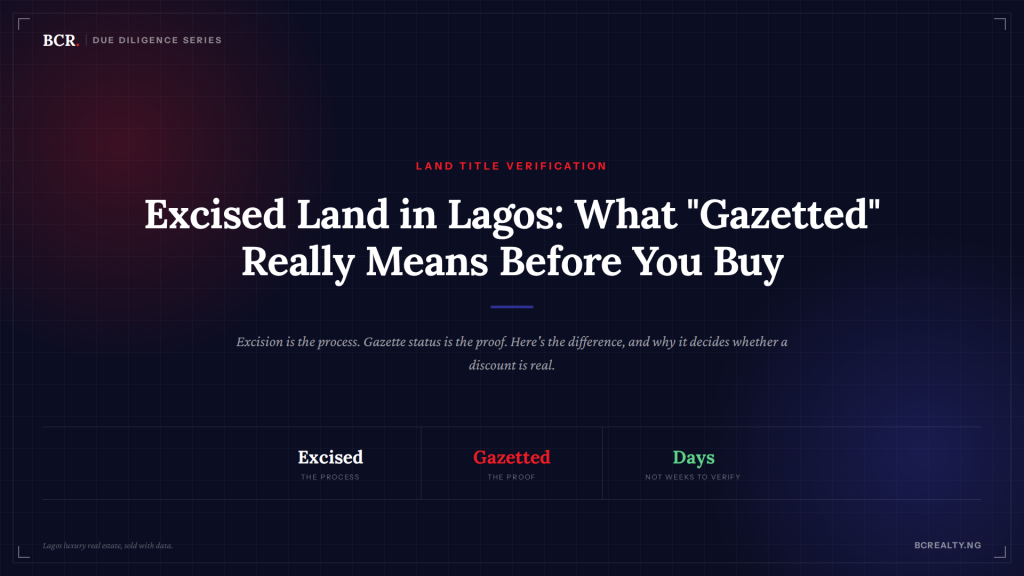
Excision is the process. It describes land that a family or community claims has been released from government acquisition.
Gazette status is the proof. It confirms whether that release has actually been published and recognised by the state.
Land can be excised without being gazetted. This is the gap where risk lives. A seller can accurately tell you the land was excised, in the sense that the process was initiated, while the part that actually matters, formal publication, never happened.
If ungazetted land carries this much risk, a reasonable question is why it gets sold at all.
The honest answer is that Nigerian land transactions do not require gazette confirmation to close. A buyer and seller can complete a sale, exchange money, and execute a Deed of Assignment entirely on the basis of an excision that has never been formally gazetted. Nothing in the transaction mechanics forces the question to be asked.
This is precisely why the lower price exists. The seller is passing along land with an unresolved legal status, and the buyer is absorbing that risk, often without realising it, in exchange for what looks like a good deal.
An ungazetted excision is not automatically fraudulent. Many excisions are genuine and simply still moving through a slow administrative process. The risk is not that the land is fake. The risk is that its legal status is unresolved, and an unresolved status has consequences that surface at the worst possible time.
None of these risks announces themselves at the point of sale. They surface later, when you are the one trying to sell, borrow against, or build on the land, which is exactly why the search needs to happen before you buy, not after.
Confirming gazette status is a documentary search, not a matter of trust. It typically involves:
This search typically takes days, not weeks, when a solicitor has direct experience with Lagos State land records. The speed is part of why skipping it is so costly by comparison. It is a short, defined piece of due diligence standing between a buyer and a discount that may not be a discount at all.
Consider two plots of similar size in the same emerging corridor. One is priced in line with recent comparable sales. The other is priced meaningfully lower, with a seller who describes the land as “excised” and available immediately.
On paper, the second plot looks like the better deal. Once gazette status is checked, one of two things is usually true: either the excision is confirmed and the discount reflects something else entirely, perhaps a motivated seller or a less desirable position within the corridor, or the excision is unconfirmed, and the discount is simply the market’s way of pricing in a risk the buyer has not yet been told about.
The price alone never answers which scenario you’re in. The gazette record does.
Is excised land in Lagos safe to buy? Excised land can be safe to buy once the excision has been confirmed as formally gazetted. Excised land that has not been gazetted carries meaningfully higher legal and resale risk, and should not be treated as equivalent to gazetted land simply because a seller describes it as excised.
What is the difference between C of O and an excision? A Certificate of Occupancy establishes an individual’s recognised right to occupy and use a specific piece of land. Excision is a separate, earlier-stage process that releases land from government acquisition at a community or family level, before individual title documents like a C of O can be properly issued against it.
How long does it take to verify gazette status? A direct search against Lagos State Gazette records, carried out by a solicitor familiar with the process, typically takes a few days rather than weeks, assuming the seller can provide accurate excision reference details to search against.
Can land be excised but not gazetted? Yes. Excision and gazette publication are two separate steps. Land can be genuinely in the process of excision, or claimed as excised, without the formal gazette publication that confirms it. This gap is where most of the risk in these transactions lives.
Why do agents rarely mention gazette status? Gazette verification requires a specific documentary search that not every agent is equipped or incentivised to carry out, particularly when the land in question is priced attractively, and the seller is motivated to close quickly.
Every emerging-corridor listing BCR represents is checked against gazette records before it reaches a client, alongside the same title and building-approval verification we apply to every prime-corridor property. A below-market price is not, on its own, a reason for concern. It is a reason to ask a specific question and to have that question answered with a document rather than an assurance.
If you’re evaluating a plot with a price that looks better than the corridor average, the gazette record is where that question gets settled. Download BCR’s full land due diligence checklist for the exact records to request and the questions a seller should be able to answer without hesitation, or book a consultation if you’d like us to run the search on a specific property.
Brick & Click Realty. Lagos luxury real estate, sold with data.
Written for people allocating capital in prime Lagos, not for a mailing list.
You are on the list
The next edition of BCR Luxury Pulse will arrive in your inbox. Look for a confirmation email first.